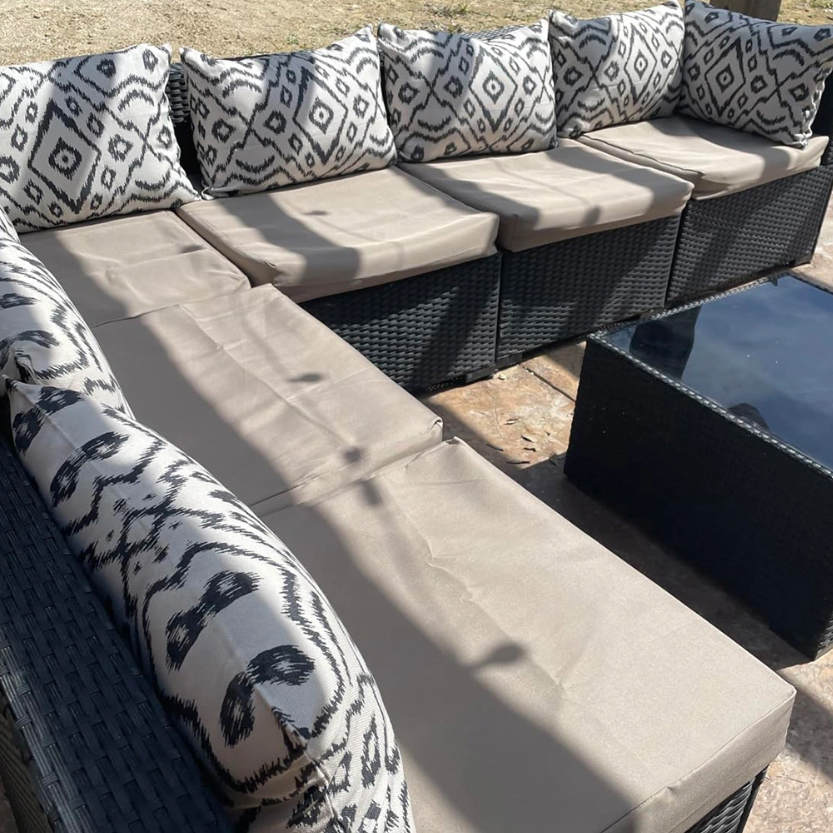
For outdoor furniture retailers, the replacement cycle is where repeat sales happen. Sun fading, rain damage, stains, and seasonal style updates push customers to rebuy long before they replace the entire furniture set. Adding customizable cushion covers lets you capture this high-intent, recurring demand while offering customers a fast, affordable refresh. Working with the right cushion covers exporter helps you scale SKUs, maintain color consistency, and deliver reliable quality across every reorder.
Why the Replacement Market Beats New Set Sales
The Customer Replacement Cycle
Outdoor cushion covers degrade faster than the furniture frames beneath them. UV exposure breaks down dye and fiber structure. Moisture and humidity accelerate mildew growth. Pets, spills, and daily use cause staining and surface wear. Customers who invested in a quality patio set are highly motivated to protect that investment with a cover replacement — and they are willing to spend on quality when the product is positioned correctly.
Common replacement triggers:
| Trigger | Customer Motivation | Retail Opportunity |
|---|
| UV fading | Covers look worn; frame still looks new | Upgrade to UV-resistant premium fabric |
| Mildew and staining | Hygiene concern; aesthetic issue | Sell mildew-resistant fabric as a feature upgrade |
| Seasonal décor change | Interior refresh extends to outdoor spaces | Introduce seasonal color drops and limited edition fabrics |
| Pet or accidental damage | Single cover replacement rather than full set | Bundle replacement covers by set (seat plus back pairs) |
| Style update | Trend shift in outdoor color palettes | New colorway releases as a reason to rebuy |
The Retail Business Case
Replacement cushion covers have a significantly higher purchase frequency than full furniture sets. A customer who buys a patio set once may replace the cushion covers every two to four years — which means your product can generate three to five revenue events over the lifespan of one furniture purchase.
Product strategy for this market:
Build refresh bundles — seat cover plus back cover sold as a pair at a bundled price
Create seasonal color drops to give existing customers a new reason to buy
Position premium fabric upgrades (solution-dyed acrylic, marine-grade fabric) as a logical step up for coastal or high-humidity customers
Custom Sizing and SKU Planning
What Custom Sizing Means in Practice
A reliable cushion covers exporter should be able to handle both standard size ranges for fast-moving retail SKUs and made-to-order options for customers with non-standard furniture dimensions.
Key dimensions to define per SKU:
| Dimension | What to Specify | Why It Matters |
|---|
| Length and width | Finished cover dimensions in cm or inches | Primary fit dimension; most common source of returns |
| Boxing depth | Thickness of the cushion the cover wraps | Shallow covers on thick cushions cause split seams |
| Corner radius | Square, rounded, or curve profile | Mismatched corners cause bunching and poor fit |
| Tie and strap positions | Back center, side ties, corner ties | Must match furniture frame attachment points |
| Closure type | Hidden zipper, overlap, or Velcro | Zipper preferred for clean finish; overlap for lower cost |
SKU Planning for Retailers
Start with the four to six sizes that cover the majority of standard patio furniture sold in your market. In the US, common seat cushion sizes run from approximately 18x18 inches to 24x24 inches; back cushions typically range from 18x18 to 24x48 inches depending on the furniture style.
Build a size matrix that allows expansion without starting over — add one size at a time as you confirm sell-through rather than launching 20 SKUs simultaneously.
Factory and Exporter Checklist for Size Consistency
Pattern control: confirm that cutting patterns are standardized and not re-drawn between orders
Tolerance standard: define acceptable plus or minus in mm for each dimension before production
Size labeling: confirm each cover is labeled by dimension, not just "small/medium/large" — descriptive labels reduce measurement-related returns
Barcode readiness: each size and color combination should have a unique barcode for inventory management
Fabric and Performance Features Retail Customers Expect
Performance Specifications That Drive Purchasing Decisions
Outdoor cushion cover buyers in the retail channel are increasingly specification-aware — particularly in markets where outdoor living is a year-round activity. The features below are the ones that appear most frequently in positive reviews and convert browsers into buyers.
| Performance Feature | Specification to Request | Why Customers Value It |
|---|
| UV resistance | AATCC 186 test; minimum 1000 hours without significant fading | Maintains appearance season after season |
| Water repellency | DWR (durable water repellent) finish; water beads off surface | Protects cushion from saturation in rain |
| Colorfastness | ISO 105 Grade 4 or above after UV and wash testing | Prevents dye transfer to cushion and fading |
| Mildew resistance | Anti-mold treatment or inherently mildew-resistant yarn | Critical for coastal, humid, and covered outdoor areas |
| Abrasion resistance | Martindale rub test minimum 15,000 cycles for seat cushions | Seat covers take the most friction; thin fabric fails quickly |
Construction Details That Justify Premium Pricing
| Construction Feature | Detail | Customer Benefit |
|---|
| Hidden zipper | Concealed behind piping or seam | Clean finish; professional appearance |
| Reinforced seam | Double-stitched with minimum 7 stitches per cm | Resists splitting at boxing corners under cushion pressure |
| Durable thread | UV-stabilized polyester thread | Thread does not degrade before the fabric does |
| Piping edge | Welted piping around perimeter | Defines shape; adds perceived quality; protects seam |
| Tie straps | Reinforced attachment point; 20 cm tie length | Secure attachment to furniture prevents sliding |
Merchandising Angle
Offer fabric tiering to support multiple price points:
Entry level: 180D polyester with standard water-repellent coating
Mid tier: 300D Oxford with UV-stabilized yarn and reinforced seams
Premium: solution-dyed acrylic or marine-grade fabric for coastal and high-sun applications
The premium tier justifies a significantly higher retail price and targets the customer with the most to lose from poor performance — which is exactly the customer who will leave a detailed positive review when the product delivers.
Branding, Packaging, and Retail Presentation
Private Label and Retail-Ready Packaging
A product that performs well but is packaged poorly loses its retail impact at the point of decision. Work with your cushion covers exporter to define packaging that supports the brand story you are building.
| Packaging Element | Specification | Retail Impact |
|---|
| Branded polybag | Clear polybag with printed brand name, logo, and size indicator | Shelf presence; inventory clarity |
| Hang tag | Die-cut card with fabric spec, size dimensions, and care instructions | Reduces pre-purchase questions; supports sizing confidence |
| Care insert card | Washing, storage, and usage instructions inside the packaging | Reduces damage-related returns from misuse |
| Size label | Sewn-in label with finished dimensions | Reduces "wrong size" returns for online orders |
| Color name system | Consistent naming across colorways (e.g., "Coastal Gray" rather than "Gray") | Supports brand recognition and seasonal collection stories |
In-Store and Online Merchandising
For in-store retail:
Color swatch cards attached to display hooks allow customers to visualize the full color range without opening packaging
Before-and-after visuals showing faded original covers versus fresh replacement covers communicate the replacement value proposition directly
For online listings:
Lifestyle photography showing the cover on a real patio in sunlight — not a white-background product shot — dramatically improves conversion
A measurement guide graphic showing how to measure cushion length, width, and boxing depth reduces sizing-related pre-purchase hesitation
Sourcing and Quality Control for Long-Term Repeat Orders
How to Evaluate a Cushion Covers Exporter for Consistency
The replacement market only works as a business model if customers can reorder the same color and size and receive a product that matches what they bought before. Color consistency across lots is therefore the most important quality variable to evaluate before committing to a supplier.
| QC Area | What to Test | Accept Standard |
|---|
| Color consistency | Compare new production lot against previous lot reference | Delta E less than 1.0 under standard lighting |
| Fabric batch tracking | Can the supplier trace each delivery back to a fabric batch and dye lot? | Full traceability required for consistent reorders |
| Zipper performance | Operate zipper 50 times; check for snag, misalignment, and slider wear | No failure or misalignment within 50-cycle test |
| Seam strength | Pull test at seam junction points | No seam separation at defined load per product spec |
| Stitch density | Visual and count inspection on seam sample | Minimum 7 stitches per cm on all load-bearing seams |
| AQL inspection | Final random inspection before shipment | AQL 2.5 for major defects; zero tolerance for critical defects |
Operational Requirements for Scale
| Operational Factor | What to Confirm | Why It Matters |
|---|
| MOQ flexibility | Minimum per color and per size for reorders | Allows you to restock fast-moving colors without overbuying slow ones |
| Lead time stability | Confirmed production weeks from purchase order | Prevents stockouts at peak season |
| Reorder process | Does the exporter maintain spec documentation between orders? | Protects consistency without re-sampling on every reorder |
| Growth readiness | Can the exporter extend into pillows, bench cushions, and chaise covers? | Allows category expansion without changing supplier relationships |
Conclusion
Customizable cushion covers let retailers monetize the outdoor furniture replacement cycle — capturing high-intent repeat buyers who want a faster, more affordable refresh than a full set replacement. The product category is straightforward, the purchase motivation is strong, and the margin opportunity is real.
The key is getting three things right: a size system that reduces returns, a performance fabric specification that earns positive reviews, and a cushion covers exporter who can deliver consistent color and quality across every reorder season after season.
FAQ
Q1: Why do outdoor cushion covers sell well as replacements?
Cushion covers are exposed to UV radiation, moisture, mildew, abrasion, and staining at a rate that degrades them significantly faster than the furniture frames beneath them. Customers who paid for quality furniture are motivated to maintain its appearance — and replacing the covers is a fraction of the cost of replacing the set. This creates a recurring purchase cycle that is highly predictable and easy to merchandise around.
Q2: What information should customers provide for custom cushion covers?
The minimum specification required for accurate custom sizing is finished length, finished width, boxing depth (cushion thickness), corner profile (square or rounded), closure type (zipper, overlap, or Velcro), and tie or strap positions if attachment to the furniture frame is required. A clear measurement guide on the product listing or in the store reduces the most common sizing errors.
Q3: How can retailers reduce sizing-related returns on cushion covers?
Use a measurement guide that shows customers how to measure length, width, and boxing depth specifically — not just overall dimensions. Name sizes by their actual finished dimensions rather than generic S/M/L designations. Work with your cushion covers exporter to define and enforce dimensional tolerances so that production output consistently matches the size chart on your listing.
Q4: What fabrics perform best for outdoor cushion covers?
UV-resistant, water-repellent, colorfast, and mildew-resistant fabrics are the performance baseline for outdoor applications. Solution-dyed acrylic and marine-grade polyester are the premium tier choices for coastal and high-humidity environments where performance demands are highest and customers are willing to pay for the upgrade. Standard 300D Oxford with DWR finish and UV-stabilized yarn covers the mid-market well.
Q5: What should I ask a cushion covers exporter before placing a bulk order?
Request the complete fabric specification including denier, GSM, coating type, and UV and water-repellency test results. Confirm the color consistency process — specifically how they match reorders to previous lots. Ask for the zipper brand and standard, seam construction detail, and stitch density specification. Confirm MOQ by color and size, production lead time, and the sample approval process before committing to bulk production.

 English
  Deutsch
  中文
中文