Returns on Amazon often come from the same issues — wrong fit, water leakage, wind blow-offs, ripped seams, and "not as described" material claims. If you sell a motorcycle cover, building the product around return-proof performance is the fastest way to protect your ratings and margins. This guide breaks down five must-have features to specify with your motorcycle cover manufacturers so your listing matches what customers actually experience when the cover is on the bike.
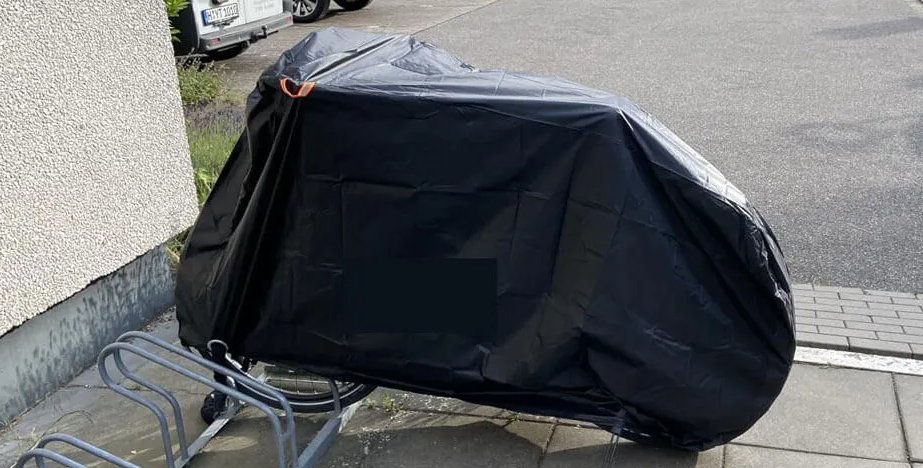
Feature One: Accurate Fit System
Why Fit Complaints Drive Returns
"Too small," "too loose," and "doesn't cover the mirrors" are among the highest-frequency complaints in the motorcycle cover category. A customer who cannot get the cover on properly returns it immediately — and the review they leave reflects the product, not their installation technique.
What to Build Into the Product
| Fit Element | Specification | Benefit |
|---|
| Elastic hem | Full perimeter elastic draw with cord lock | Accommodates wheelbase variation within size range |
| Adjustable buckle straps | Underbody strap with side-release buckle | Secures cover against wind; reduces loose-fit complaints |
| Mirror pockets | Shaped pocket at front mirror positions | Prevents the most common "doesn't fit mirrors" complaint |
| Size range | Small (scooter), Medium (sport/naked), Large (cruiser), XL (touring/adventure) | Covers the four highest-volume bike categories on Amazon |
Listing and Factory Alignment
Provide a size chart that lists cover dimensions (length, width, height, handlebar width) — not just "fits bikes up to X cc." Cross-reference your sizes against popular models in your target market: Honda CB series, Harley Sportster, BMW R series, Yamaha MT series.
At the factory level, confirm pattern consistency across production batches. A size medium that measures correctly on the sample but varies by 5 cm in bulk creates instant return triggers.
Feature Two: True Waterproofing
Why "Not Waterproof" Claims Destroy Ratings
A customer who parks a covered bike overnight in rain and finds a wet seat the next morning will leave a one-star review before considering any other factor. Waterproofing failure is one of the fastest paths to a product delisting on Amazon.
Spec Points to Confirm with Motorcycle Cover Manufacturers
| Waterproof Element | What to Specify | Standard to Reference |
|---|
| Fabric and coating | 210D or 300D Oxford with PU or PVC backing | Minimum 1000 mm hydrostatic head; 3000 mm+ for premium |
| Seam construction | Taped seams (heat-welded tape over every stitch line) | Highest waterproof standard; significantly reduces leakage risk |
| Seam binding (alternative) | Double-stitched bound seams where tape is not used | Lower protection; acceptable for water-resistant positioning only |
| Vent placement | Positioned away from rain entry angle | Prevents water ingress through the vent while maintaining airflow |
| Mirror pocket seams | Sealed or bound construction at pocket joints | High-risk leakage point if left as open-stitched seam |
Listing Alignment
The language you use in your listing must match the construction. If your seams are stitched but not taped, claiming "fully waterproof" invites "not as described" returns. Use "water-resistant" for unbound stitched construction, and reserve "waterproof" for taped-seam products. This single listing decision can reduce a significant proportion of waterproofing-related returns.
Feature Three: Wind-Proof Security
Why Blown-Off Covers Create Two Problems
A cover that blows off in wind fails in its primary function. It also creates a secondary problem: when a loose cover flaps against bodywork repeatedly, it scratches the paint — and a paint-scratch return is far harder to contest than a fit complaint.
Must-Have Design Elements
| Security Feature | Design Detail | Why It Matters |
|---|
| Underbody buckle strap | 25 mm woven strap with side-release buckle; passes under frame | Prevents vertical lift; primary wind security mechanism |
| Elastic hem with cord lock | Full perimeter elastic with adjustable tightening cord | Seals the lower edge against wind entry that causes ballooning |
| Lock grommets | Reinforced eyelet at front and rear hem | Customer can thread a cable lock through the grommet and wheel; prevents theft and blow-off simultaneously |
| Anti-flap patterning | Cover cut to motorcycle profile with minimal excess material | Reduces ballooning that causes fabric stress and flapping noise |
Sampling Test Plan
During the sampling stage, test strap and buckle durability specifically:
Pull test the underbody strap at simulated wind load (minimum 15 kg force without separation or buckle failure)
Open and close the side-release buckle 50 times minimum to confirm no cracking or release failure
Confirm elastic recovery after full extension — elastic that does not return to original length will not maintain hem tension after the first few uses
Feature Four: Heat, UV, and Fade Resistance
Why Outdoor Durability Complaints Are Delayed But Damaging
Heat and UV damage complaints typically arrive 60–90 days after purchase — outside the standard Amazon return window in many cases, but well within the review window. Customers who find a faded, brittle, or partially melted cover leave reviews that directly damage new purchase conversion.
Specification Targets
| Durability Factor | What to Specify | Test Reference |
|---|
| UV resistance | Solution-dyed yarn or UV stabilizer additive in coating | AATCC 186 or equivalent; minimum 200 hours without significant fading |
| Colorfastness | Dye permanence for black, gray, and any branded colors | Grade 4 or above on ISO 105 rating after UV exposure |
| Heat tolerance | Safe for bike surfaces after standard cool-down period | Define "cool-down before covering" guidance; do not spec for hot-engine placement |
| Fabric denier | 210D minimum for standard; 300D for premium durability | Heavier denier resists surface abrasion and puncture better |
Listing and Insert Card Strategy
Include a brief care and usage guide in the package insert. Specifically address:
Allow the engine to cool for at least 30 minutes before fitting the cover
Rinse the cover occasionally to remove particulate abrasion that degrades coating
Store folded in the included carry bag when not in use
These three instructions prevent the majority of heat-related and coating-degradation complaints that come from customer misuse — which, without guidance, generates reviews that look like product failures.
Feature Five: Tear-Resistant Construction and Scratch-Safe Lining
Why Rips and Paint Scratches Trigger Immediate Refunds
A torn cover fails visibly and publicly — customers photograph it and attach the image to their return request. A paint scratch is even more costly: the customer claims consequential damage, escalates to Amazon, and the review is highly specific and damaging to conversion.
Build Quality Details to Specify
| Construction Feature | Detail | Location |
|---|
| Reinforced seam stitching | Double-stitched with minimum 7 stitches per cm | All load-bearing seams |
| Bar-tacking | Reinforcing stitch at high-stress junction points | Strap anchor points, hem corners, handle attachment |
| Soft inner lining | Fleece or non-woven soft layer at saddle and tank contact zones | Seat area, tank sides, mirror contact points |
| Non-scratch panels | Microfiber or soft-touch material at primary contact surfaces | Front fairing and tank area on full-cover designs |
| Handle reinforcement | Padded handle with internal backing | Carry handle area — prevents tearing from weight of wet cover |
QC Checkpoints to Define Before Bulk Production
| QC Test | Method | Accept Criteria |
|---|
| Fabric tear strength | Elmendorf tear test or equivalent | Meets minimum threshold for specified denier |
| Seam strength | Seam pull test at defined load | No seam separation below specified force |
| Strap anchor integrity | Pull test at anchor stitching | No anchor detachment or fabric pull-through |
| Lining adhesion | Peel test on bonded lining | No delamination at standard peel force |
| Final visual inspection | AQL 2.5 standard | Zero critical defects; major defects within AQL tolerance |
Conclusion
Reducing returns starts before the product ships — it starts in the specification meeting with your motorcycle cover manufacturers. A cover that fits accurately, keeps water out through taped seams, stays on in wind with a proper buckle system, resists UV and heat over a full season, and never scratches paint or tears under normal use will generate reviews that sell the next unit rather than warn buyers away.
FAQ
Q1: What is the most common reason customers return a motorcycle cover on Amazon?
Incorrect sizing and fit issues are among the most frequent return triggers — covers that do not reach the front wheel, do not accommodate mirrors, or are so loose they flap and blow off. The second most common reason is waterproofing failure, where stitched-but-not-taped seams allow water ingress that the customer interprets as a product defect.
Q2: Should I claim "waterproof" or "water-resistant" on my listing?
Use the term that accurately describes your construction. If your cover uses taped seams and a high-hydrostatic-head fabric, "waterproof" is justified and defensible. If seams are stitched without tape, use "water-resistant" — it sets the correct expectation and significantly reduces "not as described" return claims from customers who park in heavy rain.
Q3: Do wind straps really reduce returns?
Yes, measurably. Buckle straps and a properly designed elastic hem prevent the two most damaging wind-related outcomes — covers that blow off entirely and covers that flap against bodywork and scratch paint. Both scenarios generate returns and negative reviews. A well-anchored cover eliminates both.
Q4: What should I confirm with motorcycle cover manufacturers during sampling?
Confirm sizing tolerances against your size chart for each SKU, seam construction type and whether tape is applied, coating type and hydrostatic head test result, buckle and strap pull strength, UV and fade resistance test results, and lining material and non-scratch performance at tank and seat contact zones.
Q5: How can I reduce "not as described" returns beyond product features?
Provide an accurate size chart that references specific bike models or dimensions rather than engine displacement. Use listing photos that show the cover on a real bike — not a rendering. Include the material specification in the bullet points (fabric type, coating, seam type). Add a short care and usage guide in the package insert that addresses cool-down requirements and storage. These elements together set accurate expectations before purchase and reduce post-delivery disappointment.

 English
  Deutsch
  中文
中文