Your fleet is already paying for fuel, insurance, and maintenance. The question is whether it's also paying for impressions.
In 2026, digital advertising costs are climbing, ad fatigue is measurable, and local visibility—the kind that builds brand recognition in the specific neighborhoods, campsites, job sites, and parking lots where your customers actually are—is harder to sustain through screen-based channels alone. Meanwhile, every SUV, Jeep, RV, and trailer in your fleet is already moving through those spaces daily, with a spare tire mounted on the back that is visible to everyone behind it.
Custom tire covers convert that spare tire into a durable, always-on brand surface. They protect the tire from UV degradation, rain, and road film while the front face carries your logo, message, or campaign. The brands that execute this well—working with capable tire cover manufacturers who can deliver consistent fit, fade-resistant printing, and scalable production—turn a protective accessory into one of the most cost-efficient impression channels in their marketing mix.
How Printed Tire Covers Work as Always-On Advertising
The Billboard Effect
A spare tire mounted on the rear of an SUV, Jeep, RV, or trailer sits at eye level for every driver, pedestrian, and parking lot visitor behind the vehicle. Unlike a bumper sticker or a magnetic sign, a full-coverage tire cover provides a large, circular print surface—typically 27 to 35 inches in diameter—that is visible from a significant distance and readable in motion.
The impression characteristics are different from digital advertising in ways that favor local brand building:
Frequency without recurring cost: a vehicle that travels the same routes daily generates repeated impressions in the same geographic area—the kind of local frequency that builds brand recognition—without a recurring media buy
Context relevance: an outdoor brand's logo at a trailhead, a dealership's name in a campground, a service company's contact information at a job site—the impression lands in a context where the audience is already engaged with the relevant activity
Dwell time: parked vehicles generate impressions for hours at a time; a vehicle parked at a popular trailhead on a Saturday morning may be seen by hundreds of people over several hours
Protection and Branding in One
Tire covers serve a functional purpose that justifies their presence independent of the branding value: UV radiation degrades rubber compounds, causing sidewall cracking and surface oxidation that shortens tire life and creates a poor visual impression. A quality cover blocks UV exposure, sheds rain and road film, and keeps the spare tire in better condition for longer.
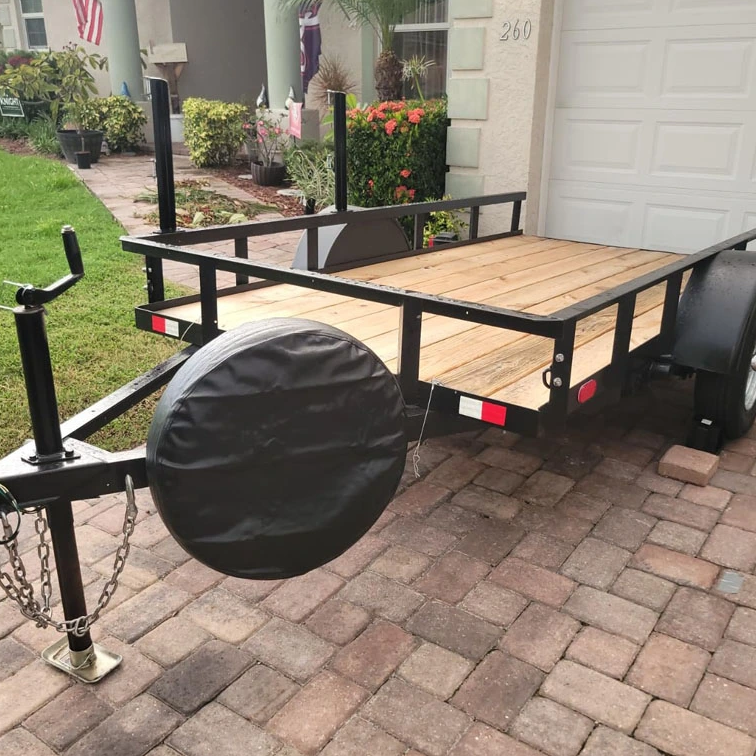
This dual function means the cover is always on the vehicle—not removed when the branding is inconvenient—which maximizes impression consistency.
Specs That Determine Performance for Tire Covers
Specifying tire covers without confirming fit, material, and print durability produces the most common failure in this category: covers that sag, slip off at highway speeds, or fade within a season—undermining both the protection function and the brand impression.
Sizing and Fit: The Most Critical Specification
| Specification | What to Confirm |
|---|
| Tire diameter | Measure the spare tire's overall diameter; cover must fit snugly without sagging |
| Tire width | Confirm the cover's depth accommodates the tire's section width |
| Fit tolerance | A cover that is too large sags and looks unprofessional; too small overstretches and stresses seams |
Fit is the specification that most buyers underestimate. A tire cover that sags communicates the opposite of the premium brand image the printing is intended to create.
Closure Style
| Closure Type | Best Application |
|---|
| Elastic hem | Simple installation; suitable for low-wind, low-speed applications |
| Drawcord | Adjustable fit across a range of tire widths; good for mixed fleets |
| Buckle/strap | Most secure; recommended for highway travel and high-wind environments |
For fleets that travel at highway speeds with the spare mounted externally, closure security is a safety and brand consideration—a cover that blows off at 65 mph is a road hazard and a brand embarrassment.
Material Options
UV-resistant vinyl: durable, easy to clean, good print surface for high-resolution graphics; standard choice for most applications
Heavy-duty fabric composites: softer feel, better conformability for irregular tire profiles, suitable for off-road and overlanding applications where abrasion resistance matters
Water and mildew resistance: essential for coastal regions, humid climates, and vehicles stored outdoors for extended periods
Print Durability
The brand exposure value of a tire cover depends entirely on the print remaining legible and visually sharp throughout the cover's service life:
UV-stable inks: specify UV-resistant printing method; covers in high-UV regions can fade significantly within one season if standard inks are used
Scratch and scuff resistance: covers are handled during installation, storage, and loading; the print surface must withstand contact without marking
Color accuracy: brand compliance requires consistent color reproduction across batches; confirm the manufacturer's color matching process before ordering at scale
Design Considerations for Maximum Readability
High-contrast layouts: dark logo on light background or light logo on dark background; avoid mid-tone combinations that lose contrast at distance
Large logo, minimal text: the primary brand element should be readable at 20–30 feet; secondary text (tagline, URL, phone number) is readable at closer range
Simple geometry: circular format rewards bold, centered designs; complex layouts with many elements lose legibility at distance
Choosing Tire Cover Manufacturers for Consistent Branding at Scale
The tire cover manufacturers you work with determine whether your brand specification is delivered consistently across a multi-location rollout—or whether each batch looks slightly different.
What to Look for in 2026
Color control and print consistency across batches Brand compliance requires that the logo color on cover batch three matches batch one. Confirm the manufacturer's color management process: do they use calibrated printing equipment, maintain color profiles per customer, and provide batch-to-batch consistency documentation?
Proofing workflow A digital mockup shows how the artwork will look on the circular cover format. A pre-production physical sample confirms fit, material quality, and print accuracy before the full order is produced. Both steps are standard practice with quality tire cover manufacturers—and their absence is a risk indicator.
Multi-SKU support Fleets with multiple vehicle types typically have multiple tire sizes. A manufacturer that can manage multiple cover sizes under a single order—with consistent branding across all sizes—reduces the procurement complexity of a multi-location rollout.
Packaging and labeling for distribution If covers are being shipped to multiple dealership locations or fleet depots, packaging that identifies size, vehicle application, and installation instructions reduces the operational friction of distribution.
How Tire Covers Generate Impressions and Protect the Spare
As shown below, custom printed tire covers serve a dual purpose — generating repeated local brand impressions while simultaneously protecting your spare tire from UV rays and harsh weather conditions.
Vehicle in public spaces
(parking • roads • events • job sites)
            ↓
Custom printed tire cover
(logo + message + brand colors)
            ↓
Repeated local impressions
(high frequency, context-relevant)
            ↓
Brand recall + inquiries
(calls • web visits • walk-ins • referrals)

UV • rain • dust • road film
            ↓
        Spare tire
            ↓
    WITH tire cover
            ↓
Reduced UV/weathering exposure
cleaner appearance, longer tire life
            ↓
Better vehicle presentation
supports brand image at every stop
Printed tire covers combine brand exposure and spare-tire protection—turning parked time and transit time into advertising time. The same cover that generates impressions at a trailhead on Saturday is protecting the tire from UV degradation on Monday.*
Best Applications for Custom Tire Covers
RV Dealerships and Service Centers
Branded tire covers on customer vehicles create dealership visibility at every campground, RV park, and rest stop the customer visits. Delivery photos with branded covers create social media content. Lot vehicles with consistent branded covers improve the visual presentation of the dealership's inventory.
Priority specification: professional print quality for customer-facing delivery; fit consistency across the tire sizes in the dealership's inventory; branding that photographs well for delivery documentation.
Outdoor and Overlanding Brands
Trailhead and campsite visibility reaches the exact audience that outdoor brands are targeting—people who are already engaged in the activity the brand serves. Influencer fleet vehicles and sponsored builds with branded tire covers generate organic impressions in high-engagement contexts.
Priority specification: abrasion resistance for off-road handling; secure closure for trail driving; design that reads well in outdoor photography.
Commercial Fleets and Local Service Companies
A service company's vehicles travel the same neighborhoods repeatedly. Tire covers with the company name, phone number, and service category generate local frequency impressions that build name recognition in the service area over time—at a cost per impression that is difficult to match with local digital advertising.
Priority specification: highway-speed closure security; durable print for daily use; simple, high-contrast design with contact information.
Events and Promotions
Pop-up activations, roadshows, and sports sponsorships benefit from consistent branded vehicle presentation. Tire covers are a low-cost way to extend the branded environment from the event space to the parking lot and the drive to and from the venue.
Priority specification: quick installation for event setup; design that aligns with the event's visual identity; removable for vehicles that serve multiple campaigns.
Installation, Selection, and TCO for Tire Covers
Installation: No Tools Required
Installing a tire cover takes under two minutes:
Clean the tire surface to remove dust and road film that can abrade the cover's inner surface
Align the graphic to the desired orientation (logo centered, text readable)
Stretch the cover over the tire, working around the circumference evenly
Secure the closure (elastic, drawcord, or strap) to confirm the cover is tight and will not shift
Verify the artwork is centered and the cover is not contacting sharp mounting hardware
Selection Steps
Provide tire sizes: measure the overall diameter and section width of the spare tire on each vehicle type in your fleet; confirm the cover size range covers all variants
Define exposure conditions: high-UV regions require UV-stable inks and UV-resistant material; coastal environments require water and mildew resistance; highway travel requires secure closure
Choose material and closure: match to the primary use case—vinyl for clean print quality; fabric composite for off-road; strap closure for highway travel
Confirm artwork requirements: provide vector logo files, brand color specifications (Pantone or CMYK), placement preferences, and the readability distance target
Pilot before full rollout: order a small batch, install on representative vehicles, and evaluate fit, print quality, and closure security before committing to the full volume order
Maintenance and Total Cost of Ownership
| TCO Factor | Consideration |
|---|
| Unit cost | One-time purchase; no recurring media cost |
| Service life | UV-stable materials and inks extend useful life; replace when print fades or material cracks |
| Impression volume | Accumulates daily across every vehicle in the fleet |
| Cost per impression | Decreases continuously as the cover generates more impressions over its service life |
| Maintenance | Mild soap cleaning to maintain print clarity; avoid harsh solvents that degrade UV coatings |
| Replacement cycle | Driven by UV exposure level and usage intensity; high-UV regions may require annual replacement |
KPIs to track during a pilot:
Estimated impressions per vehicle per day (based on route and parking patterns)
Referral mentions or lead source notes attributing inquiries to vehicle visibility
QR scan volume if a QR code is included in the design
Cover condition at 90 and 180 days to establish replacement cycle
Conclusion
In 2026, the most cost-effective brand exposure often comes from assets you already own. Every vehicle in your fleet is already moving through the spaces where your customers are—the question is whether it is carrying your brand while it does. Custom tire covers convert spare tires into durable, local, repeated impression surfaces while protecting the tire from UV and weather degradation.
The results depend on specification quality: fit that stays secure at highway speeds, materials that resist UV and moisture for the full service life, and print durability that keeps the brand sharp through daily handling and outdoor exposure. Working with qualified tire cover manufacturers who can deliver consistent color, confirmed fit across multiple tire sizes, and scalable production for multi-location rollouts is what separates a successful brand program from a one-batch experiment.
Ready to Turn Your Fleet Into a Brand Asset? Get a Configuration and Quote
Visit the product page and submit your requirements to receive a recommended specification and quotation:
View tire cover options and request a quote
To receive an accurate recommendation, submit the following:
Work conditions: UV level, rain/snow exposure, coastal salt, highway speeds, storage environment
Quantity: pilot batch size and total rollout volume; per-location breakdown
Size and spec: tire size(s) or diameter/width across your vehicle mix; material preference; closure type
Target metrics: service life target, fade resistance goal, branding readability distance
Current problems: covers slipping, print fading, inconsistent sizing across vehicle types, multi-SKU complexity
FAQ
Q1: What are tire covers?
Tire covers are protective covers that fit over a spare tire to shield it from UV radiation, moisture, dirt, and abrasion. They are available in plain protective configurations and in custom-printed versions that carry brand logos, messages, and campaign graphics. Custom-printed tire covers serve a dual function: protecting the spare tire from environmental degradation while generating brand impressions in every location the vehicle visits.
Q2: How do custom tire covers compare to decals, wraps, or magnetic signs?
Vehicle wraps and decals are permanent or semi-permanent and costly to refresh when branding changes. Magnetic signs can fall off at highway speeds, look temporary, and do not add any protective function. Custom tire covers are removable and transferable between vehicles with the same tire size, making them flexible for fleet updates and campaign changes. They add tire protection at the same time, which justifies their presence on the vehicle independent of the branding value. For local, repeated impressions in specific geographic areas, the combination of protection, removability, and large print surface makes tire covers a strong alternative to other vehicle branding formats.
Q3: What ROI can we expect from custom tire covers?
ROI from tire covers is driven by impression volume over the cover's service life compared to the one-time unit cost. A cover that generates 50 impressions per day over a 300-day service year delivers 15,000 impressions per unit—at a cost per impression that is typically a fraction of equivalent local digital advertising. The most reliable way to validate ROI is a pilot program: track referral mentions, QR scan volume (if a QR code is included), and lead source notes attributing inquiries to vehicle visibility over a 90-day period. Working with qualified tire cover manufacturers who can deliver consistent print quality ensures the impression value is maintained throughout the cover's service life.
Q4: Do we need to modify the vehicle to install tire covers?
No modifications are required. Tire covers install externally over the spare tire with elastic, drawcord, or strap closures—no drilling, no permanent attachment, and no tools required for standard installation. The only requirement is confirming that the cover size matches the spare tire's diameter and width, and that the closure type is appropriate for the vehicle's typical operating conditions (highway travel, off-road use, or stationary storage).
Q5: What parameters should we provide for selection and quoting?
To receive an accurate recommendation and quotation from tire cover manufacturers, provide: tire size or overall diameter and section width for each vehicle type in your fleet, vehicle types and primary use cases, environment and exposure conditions (UV intensity, rain/snow, coastal salt, highway speed requirements), preferred material and closure type, artwork files (vector format preferred) and brand color specifications, quantity by tire size, total rollout volume and timeline, and any performance targets (fade resistance, service life, fit security). The more specific the inputs, the more accurate the configuration recommendation and quotation.

 English
  Deutsch
  中文
中文