Egg and hanging chairs vary widely: some include a freestanding base, some hang from a C-frame, and some use double baskets. Their rounded volume and narrow support areas create fit, water-pooling and installation challenges that a rectangular cover pattern cannot solve.
The first design decision is whether the cover encloses the basket only, the basket and stand, or the complete chair including base and cushions.
Create a Three-Dimensional Measurement Set
Record overall width, depth and height, then add basket width/depth, stand projection, suspension point, base footprint and cushion volume. Photograph front, side, back and overhead views with a scale reference. Note whether the basket folds or changes angle for storage.
A supplier developing egg and hanging chair covers needs the maximum swept envelope, not only straight-line dimensions. Check clearance as the basket moves in wind.
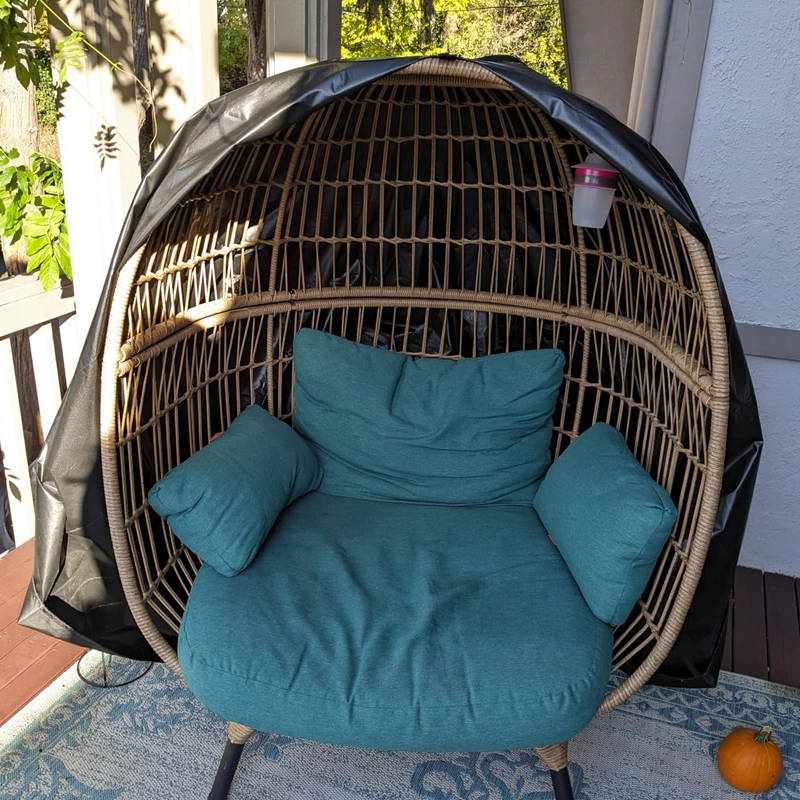
Choose the Opening Architecture
| Opening | Advantage | Design caution |
|---|
| Long vertical zipper | Easy access around bulky basket | Cover zipper with storm flap; protect chair finish |
| Rear opening | Clean front appearance | May be hard to reach near a wall |
| Bottom opening only | Fewer water-entry points | Requires lifting a large cover over the frame |
| Two-way zipper | Flexible installation | Stops and sliders need cycle testing |
Place zippers away from standing-water zones. Add an inner guard if teeth or slider could scratch a coated metal frame. Test opening length with the intended user and packaged cover weight.
Prevent Water Pools on Rounded Shapes
A close upper pattern, darts and shaped seams can help water shed. Excess fabric between the stand and basket may form a basin. The chair itself may also have horizontal cushion surfaces that support the cover, so evaluate with cushions both installed and removed.
For a waterproof cover for egg chair applications, seam construction and sealing should be appropriate to the target water test. Vents should release humid air without facing prevailing rain directly.
Design Wind Restraint Around the Frame
Hem cord or elastic for continuous lower tension
Buckled strap under the base or around a stable frame member
Leg loops positioned away from sharp welds
Vent panels to reduce internal pressure
Reinforcement where straps transfer load to fabric
Never route a restraint through a moving suspension joint. Confirm that the secured cover cannot pull the chair over; the product user may still need to store furniture during severe weather.
Sample Tests for an OEM Program
Inspect fit, zipper operation, seam appearance, water shedding and restraint after repeated installation cycles. Include UV/colorfastness, coating adhesion, tensile/tear, seam strength, cold-flex or mildew tests when the market specification requires them.
Pack the cover using the production folding method and repeat fit after storage. Thick coated fabric can retain folds that affect the first installation.
Frequently Asked Questions
Should cushions stay under an egg chair cover?
Only if the cover is designed and ventilated for that volume and the cushion supplier permits outdoor storage. Moisture can still accumulate.
Is a zipper necessary?
Not always, but it can greatly improve installation on tall or enclosed frames. Validate access with the real chair.
How is wind resistance tested?
Test the complete chair, cover, vents and restraints under defined conditions. Avoid claiming a universal wind speed without evidence.
Can one cover fit single and double egg chairs?
A loose universal design may fit several models, but fitted retail programs normally require separate patterns or graded sizes.
Prototype the Hardest Chair Variant
Send OEMCOVER drawings, photographs and the intended enclosure boundary. A full-size sample should prove access, water shedding, wind restraint and finish protection before the pattern is graded for a range.

 English
  Deutsch
  中文
中文